Mackenzie Beach
Larnaca’s social beach: bars and tables on the sand, the salt lake behind, and aircraft dropping in low over the water.
First-time visitors and short trips — the airport is ten minutes away
April to June, September to November
Lefkara and Kato Drys, Zygi, Cape Kiti
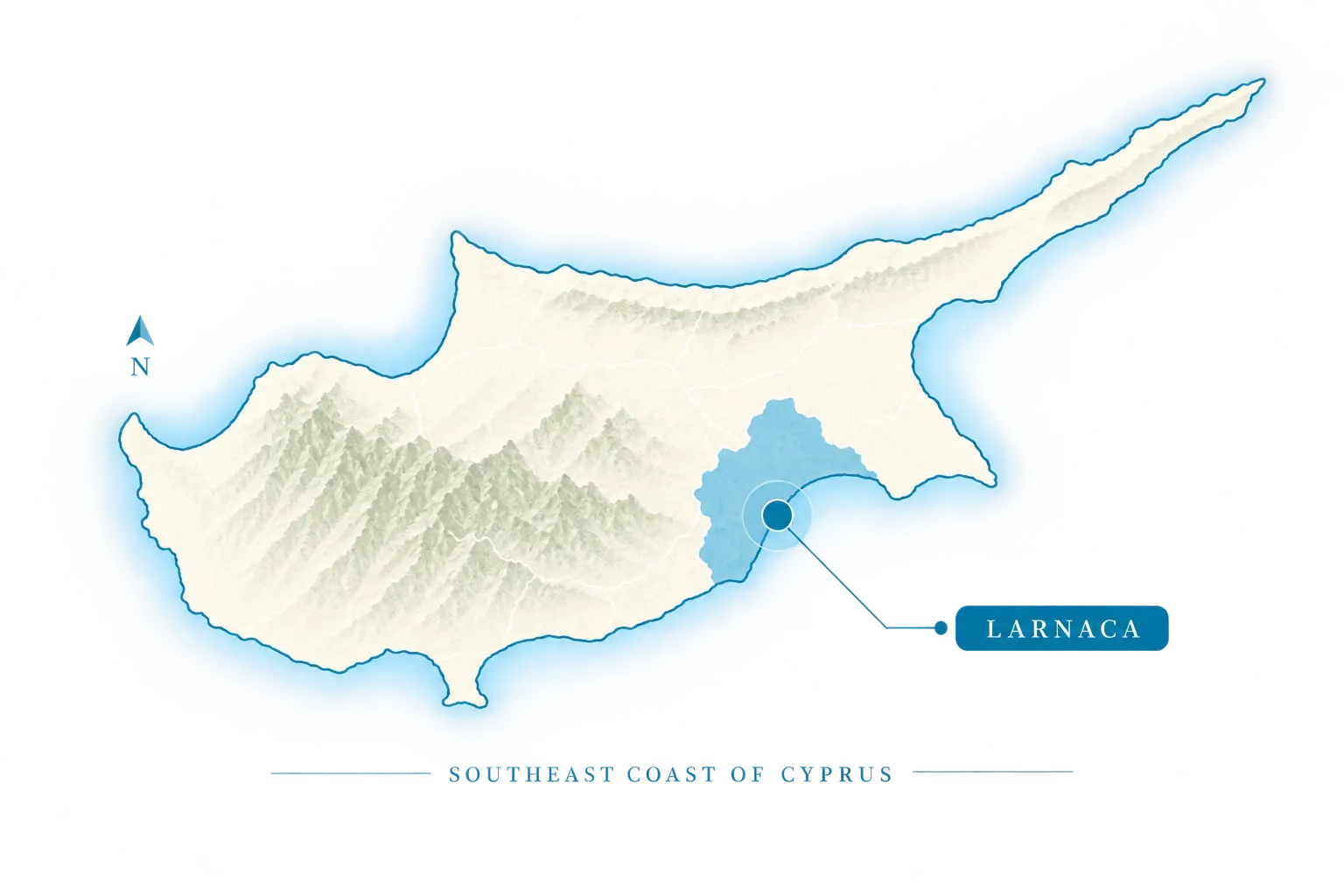
Larnaca is one of the oldest continuously inhabited cities in Cyprus — once the ancient kingdom of Kition, a Phoenician city-state rich in trade and culture. Traces of Kition still sit inside the modern city, where ruins stand beside palm-lined beaches and elegant promenades.
From Saint Lazarus Church to the easy pace of Finikoudes, Larnaca blends thousands of years of heritage with sunshine, family days out and warm local hospitality. The salt lake fills with flamingos each winter, and the Lefkara hills are half an hour inland.
Perfect for
Easy beach days, historic streets, lively squares, marina views and family travel
Larnaca today
Air: MET NorwaySea: NOAA Coral Reef Watch
Finikoudes runs through the middle of the city — palms, cafés, calm shallow water and lifeguards in season.
Saint Lazarus church, the castle at the end of the promenade, and Kition beneath the modern streets.
The salt lake on the airport road fills each winter and brings thousands of flamingos with it.
Find places to stay, eat, explore and experience the city.
Beaches & Coast
Blue-flag beaches, promenades and seaside spots.
ExploreSightseeing
Churches, landmarks, museums and historic places.
ExploreThings to Do
Activities, experiences and ways to spend your day.
ExploreVillages
Traditional villages, stone lanes and slower afternoons.
ExploreHidden Gems
Smaller places and experiences worth discovering.
ExplorePlaces to Stay
Hotels, apartments and places to stay in Larnaca.
Places to Eat
Restaurants, cafés and places to eat in Larnaca.
Larnaca’s social beach: bars and tables on the sand, the salt lake behind, and aircraft dropping in low over the water.
Town beach with palms down its spine — cafés on one side, the Mediterranean on the other.
A green garden in Dromolaxia with a chapel, decorative animal figures and an outdoor playground.
The city’s landmark church, a short walk behind the Foinikoudes seafront.
The fort at the far end of Foinikoudes — climb it for the length of the promenade.
A 178-metre ferry on its side ten minutes off Larnaca — consistently ranked among the world’s top ten wreck dives.
Twenty-odd Ottoman arches on the Limassol road, lit after dark and free to walk up to.
One of the oldest monasteries in the world, on a lone peak above the Larnaca plain — founded, tradition says, by Saint Helena in the 4th century.
Larnaca's first seafront street, running on from Foinikoudes past the fish tavernas — quieter than the palm promenade, and better at sunset.
Four connected lakes covering 2.2 km² beside the airport road — dry and white in summer, and full of flamingos from November.
One of the best-preserved Neolithic settlements in the eastern Mediterranean, UNESCO-listed since 1998, with five round houses rebuilt on site.
A mosque and shrine among palms on the west shore of the salt lake, built over the tomb of Umm Haram — one of the most significant Islamic sites in the Mediterranean.
A Venetian watchtower standing alone in a field near Cape Kiti — square, shut, and almost never visited.
A green garden in Dromolaxia with a chapel, decorative animal figures and an outdoor playground.
A 178-metre ferry on its side ten minutes off Larnaca — consistently ranked among the world’s top ten wreck dives.
Larnaca's first seafront street, running on from Foinikoudes past the fish tavernas — quieter than the palm promenade, and better at sunset.
Four connected lakes covering 2.2 km² beside the airport road — dry and white in summer, and full of flamingos from November.
Needlework since the 14th century, silversmiths on the square, and lanes built for shade rather than cars.
A fishing village turned fish-tavern strip: whatever came in this morning, grilled whole, on the quay.
Lefkara’s quiet neighbour: beekeepers, a folk museum and almost no traffic.
Lefkara’s quiet neighbour: beekeepers, a folk museum and almost no traffic.
A Venetian watchtower standing alone in a field near Cape Kiti — square, shut, and almost never visited.
Driving on the left, cards and cash, whether you need a car at all — the practical questions, answered.
Good to KnowChoose your kind of day
Larnaca works well as two separate visits: the seafront and old town, then a village outing. Foinikoudes, the castle and Saint Lazarus introduce the city; Lefkara and Kato Drys shift the focus to craft and village streets.
Begin with Saint Lazarus and the castle, then leave time for Foinikoudes. Keep Mackenzie for a beach-focused visit, and choose Lefkara or Kato Drys for another day instead of treating every village as a quick detour.