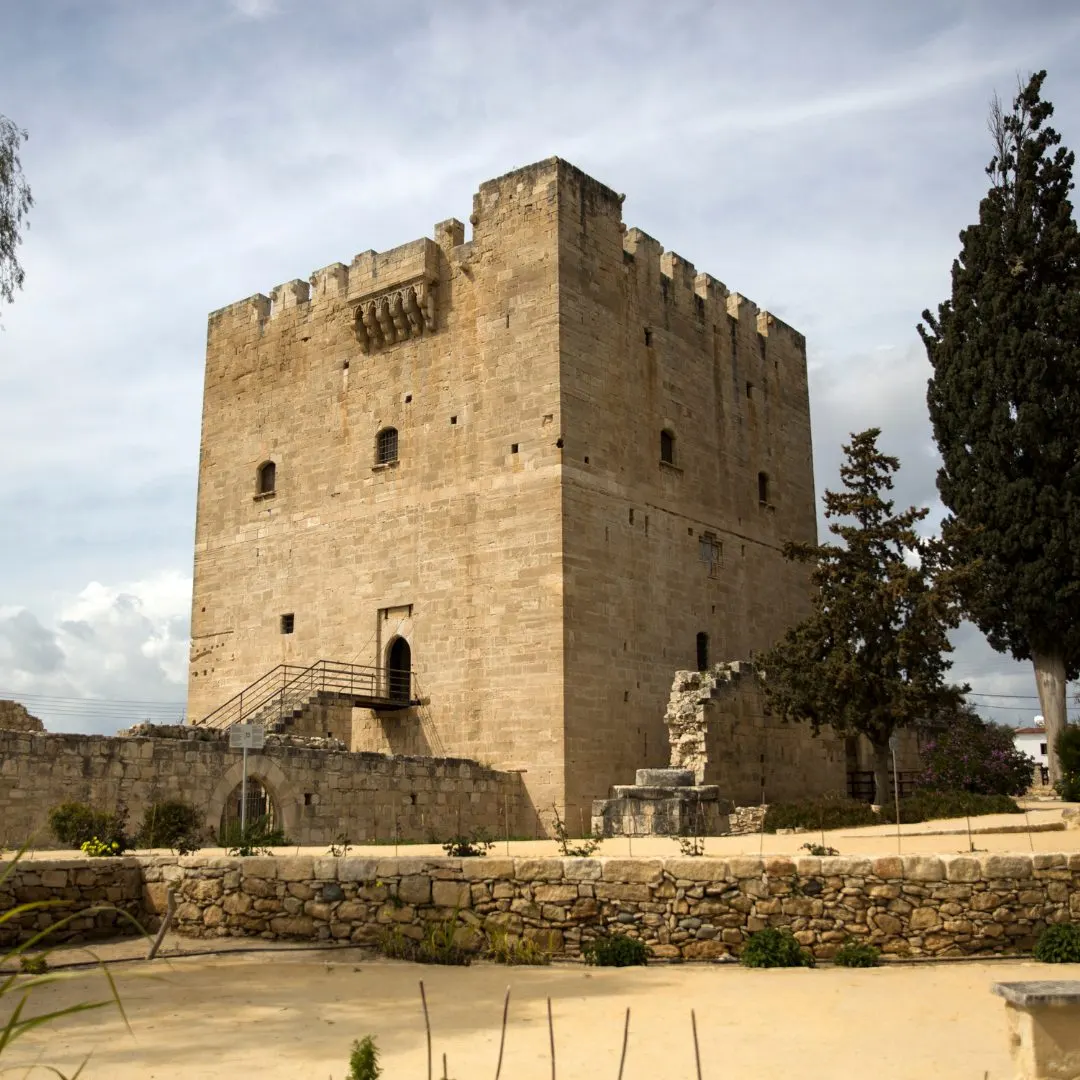
Kolossi Castle is a three-storey medieval keep in Kolossi village, west of Limassol. The visit connects military architecture with the agricultural estate around it: look beyond the tower to the sugar-mill ruins, then follow the stairs through the keep to understand how it was used.
The Hospitallers and Commandaria
The first castle dates to the thirteenth century. Kolossi became a headquarters of the Knights of St John, also called the Hospitallers, with a short period under the Knights Templar in the fourteenth century. The Commandaria name is associated with this commandery and its wine trade; the wine’s story is older than the surviving tower.
Inside the keep and up to the roof
The present keep dates to 1454 and is associated with Louis de Magnac. Look for the carved heraldry outside, vaulted rooms, fireplaces and the mural of the Crucifixion inside. Stone steps and a drawbridge lead to the entrance; internal stairs, including spiral flights, continue upwards. If stairs are a difficulty, contact the site before planning the climb.
The sugar mill is a separate building
The fourteenth-century sugar mill stands beside the keep, rather than inside its living quarters. Its remains explain why this was an economic centre as well as a fortified residence. Keep the tower and the industrial ruins distinct as you explore the site.
Opening hours and tickets
The official tourism listing gives seasonal hours and a standard €2.50 admission fee, checked on 4 October 2026. It lists closures on Christmas Day, New Year’s Day and Greek Orthodox Easter Sunday. Hours and fees can change; confirm with the site on +357 25 934 907 before travelling.
More sightseeing around Limassol
Kourion Archaeological Site
A city-kingdom on a limestone bluff a hundred metres above the sea — theatre, baths, mosaics and gladiators’ house.
Limassol Old Port
Built in the 1950s under British rule; now restaurants and fishing boats.
Molos Promenade
The seafront park and walkway that runs to the marina — sculpture, lawns, sea on one side.
Limassol Marina
The first super-yacht marina in Cyprus — shops, restaurants and residences on the water.