The money Cyprus used until 2008 — and why nobody called it the pound
For 129 years Cyprus had its own money, and for all of that time it had two names. The English on the note said one pound. The Greek and the Turkish, printed on the same face, both said lira. Everyone on the island used the second one.
The Cypriot pound outlasted British rule, three constitutions and the division of the island, and it was still worth more than the euro on the day it was withdrawn. It stopped being money on 1 January 2008. The notes in the drawer are now worth whatever a collector will pay for them, and not a cent more.
A currency that arrived with the British
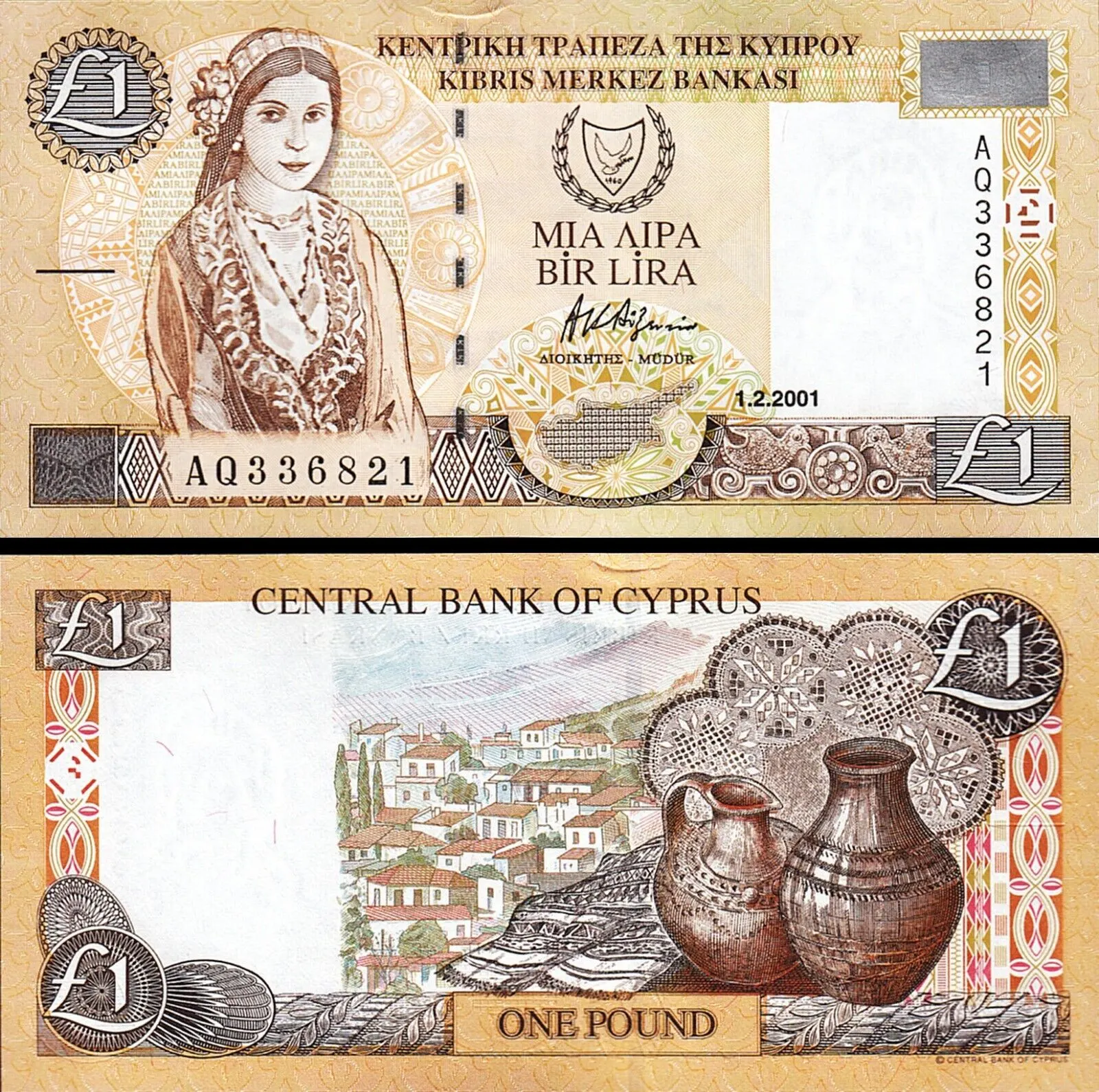
A one-pound note of June 1955. ΜΙΑ ΛΙΡΑ, BİR LİRA — and, in English, One Pound.
Britain took over the administration of Cyprus in 1878, and the following year the Cyprus pound was introduced to replace the Ottoman currency in circulation. It was pegged to sterling at par and stayed there for decades. When the island became a Crown Colony in 1925 the pound became its official currency, issued by the Government of Cyprus and carrying the reigning monarch.
The other name is an inheritance from what came before. Lira is what the Ottoman currency was called, and it is what people went on calling the money whatever the English said. Both languages of the island kept it — μία λίρα, bir lira — and the Central Bank went on printing both, in full, on every note it ever issued.
From the Ottoman lira to the euro
1879
The Cyprus pound is introduced
A year after Britain takes over the administration of the island, a new pound replaces the Ottoman currency and is pegged to sterling at par.
1925
Cyprus becomes a Crown Colony
The pound becomes the colony’s official currency. Notes are issued by the Government of Cyprus and carry the reigning monarch.
1960
Independence
The new Republic keeps the currency it inherited — and keeps both of its names.
1963
The Central Bank of Cyprus is founded
Issuing the currency passes to the new central bank, and the notes turn to Cypriot subjects: archaeology, villages, wildlife, rather than a head of state.
3 October 1983
The mil gives way to the cent
The pound had been divided into 1,000 mils. It is redenominated into 100 cents, and a new set of coins follows it into circulation.
1 May 2004
Cyprus joins the European Union
The pound has four years left.
1 January 2008
The euro arrives
The Cypriot pound is retired at an irrevocably fixed rate of €1 = £0.585274 — about €1.71 to the pound.
The notes people remember
The Central Bank’s own series — the one still folded into drawers all over the island — ran to four notes: one, five, ten and twenty pounds. Each was printed in Greek, Turkish and English, and each put something Cypriot on the back rather than a head of state.
One pound: a girl in traditional dress on the front, Kato Drys on the back.
The one-pound note is the one people are sentimental about. The front carries a young woman in traditional dress; the back is the village of Kato Drys laid out on its hillside, with Lefkara lace and two clay pots set beside it. It is a small piece of national self-portraiture — the note saying the island is its villages and the things they make by hand.
The five went further back still: a limestone head of a young man from the fifth century BC on the front, and on the reverse the church at Peristerona with a mosque standing behind it, the two of them in one frame.
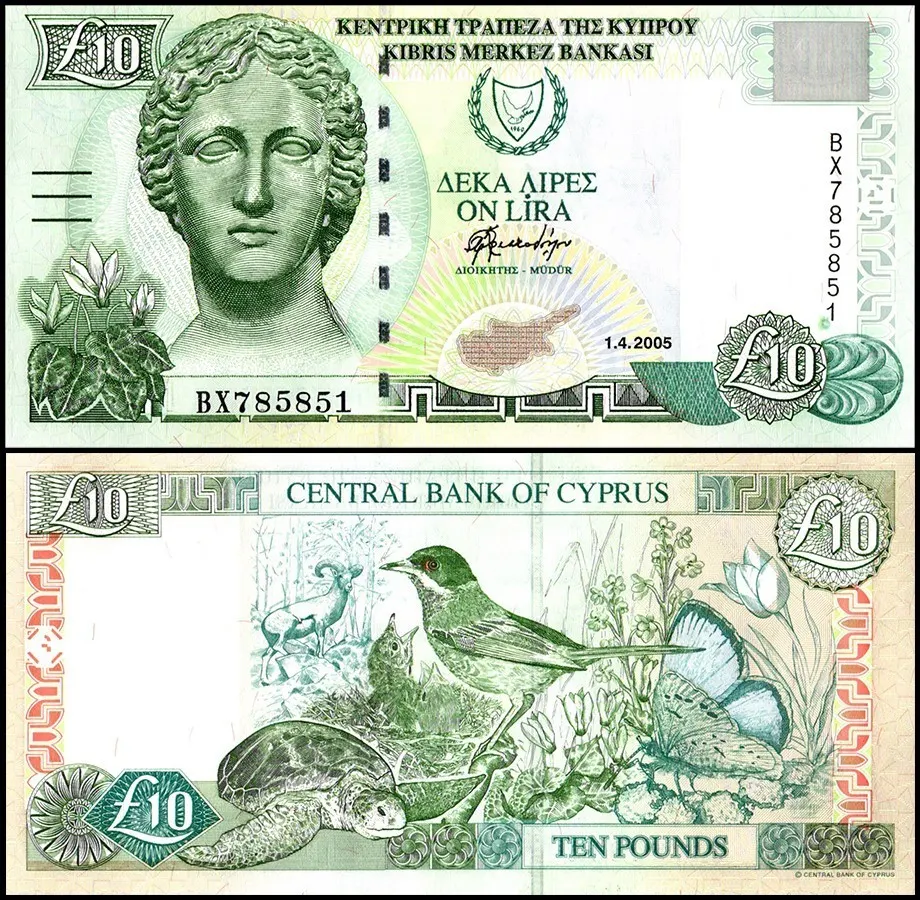
Ten pounds: Artemis on the front, and on the reverse the island’s own wildlife.
The ten was the naturalist’s note. A Roman-period marble head of the goddess Artemis on the front; on the back a green turtle, a warbler feeding its young, a butterfly, a cyclamen — and, small and high on the left, a mouflon, the wild sheep that lives nowhere else on earth.
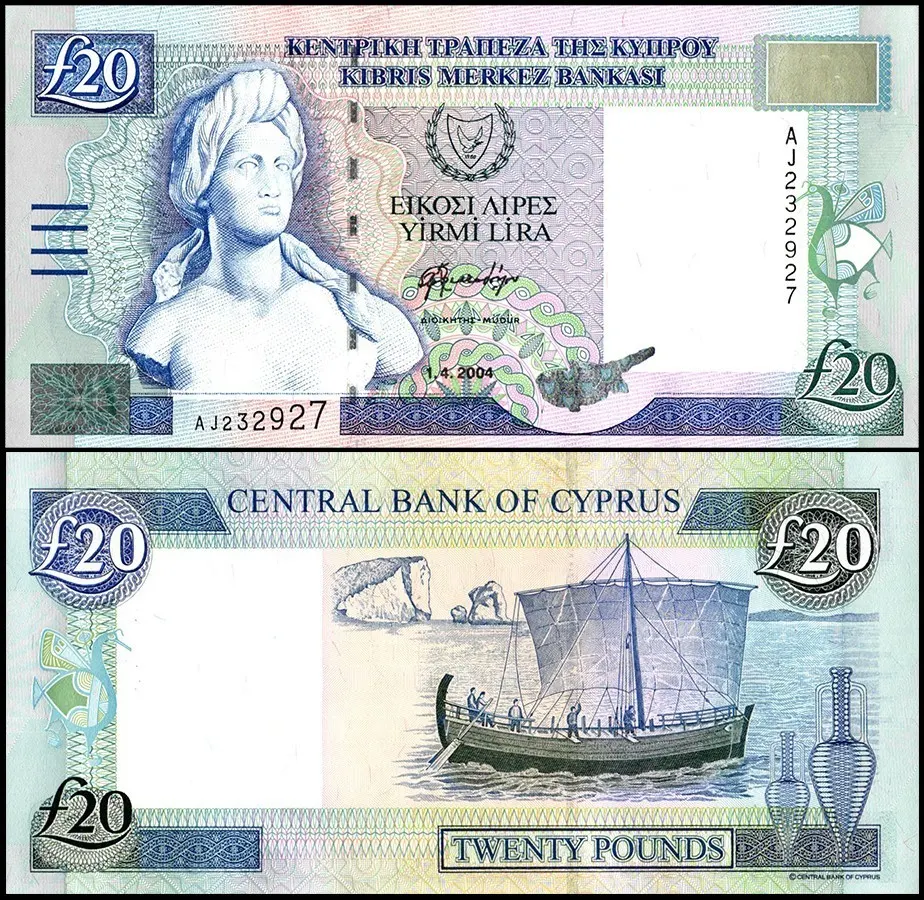
Twenty pounds: Aphrodite, and a fourth-century BC merchant ship off the rock she was born from.
The twenty, the largest denomination, went to Aphrodite — a bust of the goddess who, in the story, came ashore at Petra tou Romiou. The reverse shows a merchant ship of the kind excavated off Kyrenia in the 1960s, sailing past that same rock, with two amphorae stacked at the edge of the frame.
The switch to the euro
The last decimal coins, on the note they were spent alongside.
Cyprus joined the European Union on 1 May 2004 and adopted the euro on 1 January 2008. The conversion rate was fixed in advance and could not move: €1 = £0.585274, which put the pound at about €1.71. For a fortnight both currencies were legal tender, and then the lira stopped being money.
People here still convert in their heads, usually in order to argue that everything was cheaper before — a conversation you will hear in any kafeneio, and one worth taking with some salt. A pound was worth more per unit than a euro, which is not the same as buying more. What is harder to argue with is that the notes were better looking. A country that puts a village, a turtle and a wild sheep on its money is telling you what it thinks it is.
Google Analytics sends limited measurement signals without analytics cookies before you choose or if you reject. Accept enables analytics cookies. You can change your choice in Cookie settings.